

Touchless weapons detection · NJ · NY · PA
Concealed weapon detection for the places people gather.
Concealed weapons detection that keeps people moving and feeling safe. We design, install and support Motorola Solutions Concealed Weapons Detection, powered by Evolv, so schools, hospitals, stadiums and corporate campuses can screen for threats without turning entrances into bottlenecks.
- Motorola Solutions
- Evolv Technology
- Inc. 5000
- Serving New Jersey businesses since 1997
What is concealed weapon detection?
Concealed weapon detection (CWD) is the practice of screening people as they enter a building or venue for weapons hidden on the body or in bags. Traditionally that meant a walk-through metal detector, a wand and a table for bag checks. Modern concealed weapons detection systems keep the same goal but change the experience: people walk through at a normal pace, most everyday items stay in pockets and bags, and the system draws a trained operator’s attention to the specific people, and the specific places on a person or bag, that warrant a closer look.
It is important to be precise about what that means. A concealed weapons detection system does not “find every weapon,” and it does not make decisions. It is a sensor and an alerting tool. People still decide. The value comes from pairing the technology with a well-designed entrance, clear policies, trained staff and a plan for what happens after an alert. That is the work Rivell does.

Chapter 01 · The solution
Why organizations are moving beyond traditional metal detectors
Conventional walk-through metal detectors are proven and inexpensive, and for some sites they remain the right tool. But they can slow down lines, trigger frequent nuisance alarms on keys, phones and belts, and often depend on bag searches and divestment trays to keep people moving. Modern concealed weapons detection aims to focus staff attention on likely threats while letting most visitors walk through at a normal pace.
What AI weapons screening changes
Higher throughput at busy entrances, so lines keep moving.
A less intrusive experience for students, patients and guests.
Actionable alerts integrated with video and access control systems.
Analytics to continuously refine staffing and layouts.
Throughput numbers quoted in brochures are maximums under ideal conditions. DHS points out that real-world “effective throughput” depends on checkpoint design, procedures, number of lanes and how quickly alerts are resolved — which is exactly what good planning addresses. [S4]
Concealed weapon detection vs. metal detectors →
Chapter 02 · How it works
How a modern weapons detection system works
Most walk-through weapons screening systems used at entrances today are built on electromagnetic sensing — essentially an advanced, high-throughput evolution of metal detection — combined with software that analyzes the signals. The U.S. Department of Homeland Security’s 2024 market survey of walk-through weapons screening systems describes the Evolv Express platform (the platform Motorola Solutions Concealed Weapons Detection is based on) as using active electromagnetic sensing, magnetic signatures and AI-powered signal analytics to alert operators to potential weapons while ignoring most harmless personal items, with image-aided alarms that show where the potential threat is on a person or in a bag. [S4][S2]
01Walk through
Visitors walk through the lane at a natural pace without stopping. Most people do not need to empty their pockets.
02Alert
If the system detects an object that matches its threat profile, the operator’s tablet shows an image of the person with the location of the potential item highlighted.
03A trained person decides
An alert is not a conclusion. A trained staff member performs targeted secondary screening — a brief conversation, a bag check or a wand — following your written procedures.
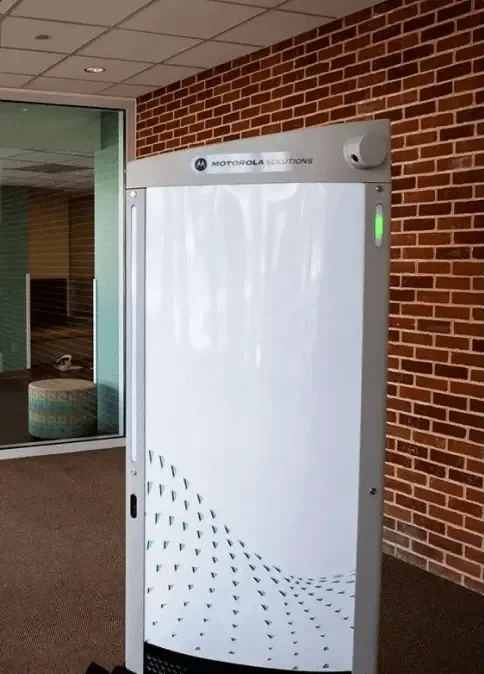
Motorola Solutions Concealed Weapons Detection, powered by Evolv
Motorola Solutions introduced Concealed Weapon Detection through an agreement with Evolv Technology in 2021, adding it to its video security and analytics portfolio. Alerts can be sent into Motorola Solutions’ Avigilon video management platform so security teams see live video alongside the alert. [S1][S2]
For organizations that already use Avigilon cameras or Motorola Solutions radios and command tools, that integration is a practical advantage: screening becomes part of one security picture rather than a stand-alone gadget.

Chapter 03 · Why Rivell
Where Rivell fits: we are your implementation partner
We are not the manufacturer. Rivell is the regional integrator that makes the technology work in your building. A weapons detection system is only as good as its deployment, so we own the details: site surveys and entrance planning; system design, procurement and installation; network, power and cybersecurity; integration with Avigilon video, access control, alarms, emergency communications and visitor management; staff training, written procedures, acceptance testing and documentation; and ongoing maintenance, tuning and support. We are headquartered in Sewell, New Jersey. New Jersey, New York and Pennsylvania, with projects nationwide.
Why Rivell →

What we deliver
- On-site assessmentsand entrance planning.
- System design, procurementand installation.
- Integration with Avigilonand other security platforms: video surveillance, access control, alarms, emergency communications, visitor management, plus network and cybersecurity.
- Training, maintenanceand continuous optimization.
Chapter 04 · Industries
Weapons detection for schools, hospitals, venues and workplaces
- K-12 Schools & Districts
- Higher Education
- Hospitals & Healthcare
- Stadiums & Arenas
- Corporate Offices & Campuses
- Government Buildings & Courthouses
K-12
Support safer learning environments while reducing morning bottlenecks and intrusive searches.
Planning comes first: our site survey
Before anything is recommended, we walk your entrances with you. A Rivell site survey reviews your current entrances, screening process and incident history; estimates throughput and staffing requirements; identifies where concealed weapons detection adds value — and where other controls are needed instead; and delivers a practical deployment roadmap and budget range.
Some sites need one lane at one door. Others need a mix of screening lanes, policy changes, cameras and access control. Our job is to tell you which.
Honest by design
Designed for real-world risk, not marketing hype
No AI-enabled weapons detection system is perfect or foolproof. The technology flags potential items for trained operators to assess; it cannot ensure that every prohibited item is detected.
Detection performance depends on configuration, sensitivity settings, placement, staffing and ongoing tuning, and every sensitivity choice is a trade-off between catching more and alarming more. Regulators have taken action against overstated claims in this industry, which is why we encourage every buyer to ask for independent test evidence and to set expectations honestly with their community. [S7]
We’ll walk through false-alarm behavior, limitations and best practices so leadership, staff and stakeholders have a realistic understanding of performance.
AI concealed weapon detection: what it can and can’t do →Concealed weapon detection FAQ
Is concealed weapons detection a replacement for metal detectors?
Not always. In some environments a concealed weapons detection system can replace traditional walk-through metal detectors. In others it becomes one layer in a broader program that includes policies, staffing, cameras, access control and emergency response planning.
Can any system guarantee detection of all weapons?
No. No screening technology can guarantee detection of every threat. Performance depends on configuration, placement, staffing and ongoing tuning. We help you set realistic expectations and build layers around the technology.
Do people have to stop or empty their pockets?
Most visitors walk through at a normal pace with phones, keys and similar items in place. People who cause an alert are directed to a brief secondary check.
Where does Rivell provide concealed weapons detection services?
New Jersey, New York and Pennsylvania, with projects nationwide.
How do we get started?
With a site survey. We review your entrances, current screening process and goals, then recommend whether concealed weapons detection is a fit and what a deployment would involve.
Site assessment
Start with a plan, not a purchase
- 01Review current entrances, screening process and incident history
- 02Estimate throughput and staffing requirements
- 03Identify where CWD adds value and where other controls are needed
- 04Deliver a practical deployment roadmap and budget range
Continue exploring
Request a site survey
Start with your entrances, your people and a practical plan.
Sources
- [S1]Motorola Solutions Introduces Concealed Weapon Detection Solution to Alert Security Teams of Hidden Weapons — June 9, 2021
- [S2]Evolv Technologies Holdings, Form 10-K for fiscal year 2021
- [S4]DHS SAVER, Walk-Through Weapons Screening Systems for Mass Casualty Threats — September 2024
- [S7]FTC v. Evolv Technologies Holdings, Stipulated Order — November 26, 2024